
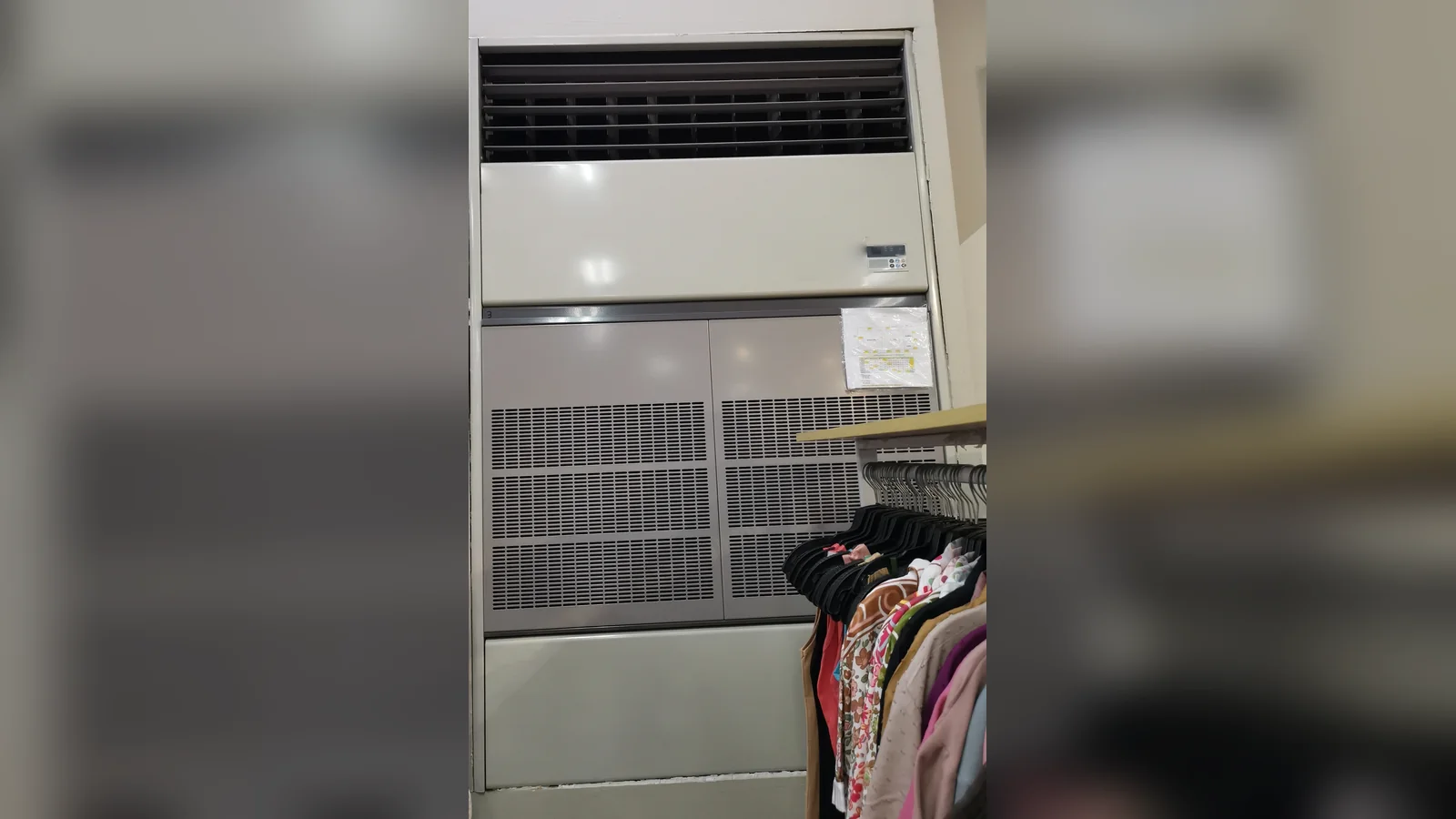
Photo: Nameless245 (CC BY 4.0, labels removed)
- What do HP, BTU and "ton" mean on a floor-standing aircond?
- How do you work out the floor standing aircon HP a space needs?
- Which factors push the HP up?
- What happens when the HP is too low?
- Why is a bigger unit not the safe choice?
- Measure the busy hour, then book the survey
What do HP, BTU and "ton" mean on a floor-standing aircond?
HP, BTU/h and "ton" are three names for one thing: how much heat an air conditioner removes from a space each hour. HP is the everyday shop label, but it is a sales class, not a measured figure. Compare models by rated cooling capacity in BTU/h or kW.
Acson's R32 floor-standing A-Series is listed as 3 to 5 HP on its product page; the linked catalogue gives 29,000 to 48,000 BTU/h, measured at 27°C indoors and 35°C outdoors, not in a shoplot at 3 pm.
How do you work out the floor standing aircon HP a space needs?
Start with floor area and ceiling height, then add the space's heat sources. Daikin Malaysia's sizing guide says to measure each room's length, width and ceiling height, plan 10 percent more BTU than standard for a high ceiling, and add 10 to 20 percent on top of the base figure in a warm climate such as Malaysia's.
The same guide (Daikin Malaysia, February 2020, updated September 2025) adds 4,000 BTU for a kitchen. Those rules suit home rooms; a single room with a low window may suit a floor mounted aircon console better than a tall cabinet.
Which factors push the HP up?
Anything that adds heat or lets heat in raises the capacity a space needs: a high ceiling, glass facing the afternoon sun, a peak-time crowd, cooking, lighting and a door that opens all day. Two shoplots of equal floor area can need very different units.
| Factor | Why it changes the HP needed | What to tell whoever sizes the unit |
|---|---|---|
| Floor area | More air and surfaces to cool | Length and width, plus any mezzanine |
| Ceiling height | More air to cool | Ceiling height; false ceiling or exposed roof |
| Sun on glass | Sun through a glass frontage heats the space directly | Which way the glass faces; tint or blinds |
| People at peak | Each person gives off heat; a restaurant at lunch peaks hard | Highest headcount and when |
| Cooking and equipment | Stoves, fryers, chillers and lighting add heat | What runs there; open kitchen or not |
| Door traffic | Each opening lets hot air in | How often it opens |
What happens when the HP is too low?
An undersized floor-standing aircond runs flat out for hours and never brings the space down to the set temperature. It copes in the morning, then falls behind once sun, customers or cooking add heat. A lower set point cannot add capacity the unit lacks.
Because that looks like a fault, the floor-standing aircon not-cold checklist rules out blocked vents and dirty filters before blaming size.
Why is a bigger unit not the safe choice?
An oversized floor-standing aircond reaches the set temperature fast and switches off before it can pull moisture out of the air, leaving the space cold but clammy. Daikin Malaysia's sizing guide adds that an oversized unit cycles on and off inefficiently, consuming more electricity and costing extra money.
Measure the busy hour, then book the survey
Write down the floor area, ceiling height, glass direction, peak headcount and heat sources for whoever sizes the unit, and raise them at the floor-standing installation survey, which covers the indoor position, condenser, pipe and drain routes and power supply; the customer approves the quote before work starts.
See commercial aircond services, residential aircond services, or floor-standing aircon service for a unit already running. Book through the contact page or WhatsApp +60 18-355 5162.
Frequently Asked Questions
Sources: Tips to Select The Right/Best Air Conditioner Size — Daikin Malaysia (2025-09); R32 Floor Standing A-Series (Non-Inverter) — Acson Malaysia (2025-06)
Talk to an Aircon Hero Technician
Seven days a week across Klang Valley. Send the brand, model and what the unit is doing, and the job is quoted before any work starts.