
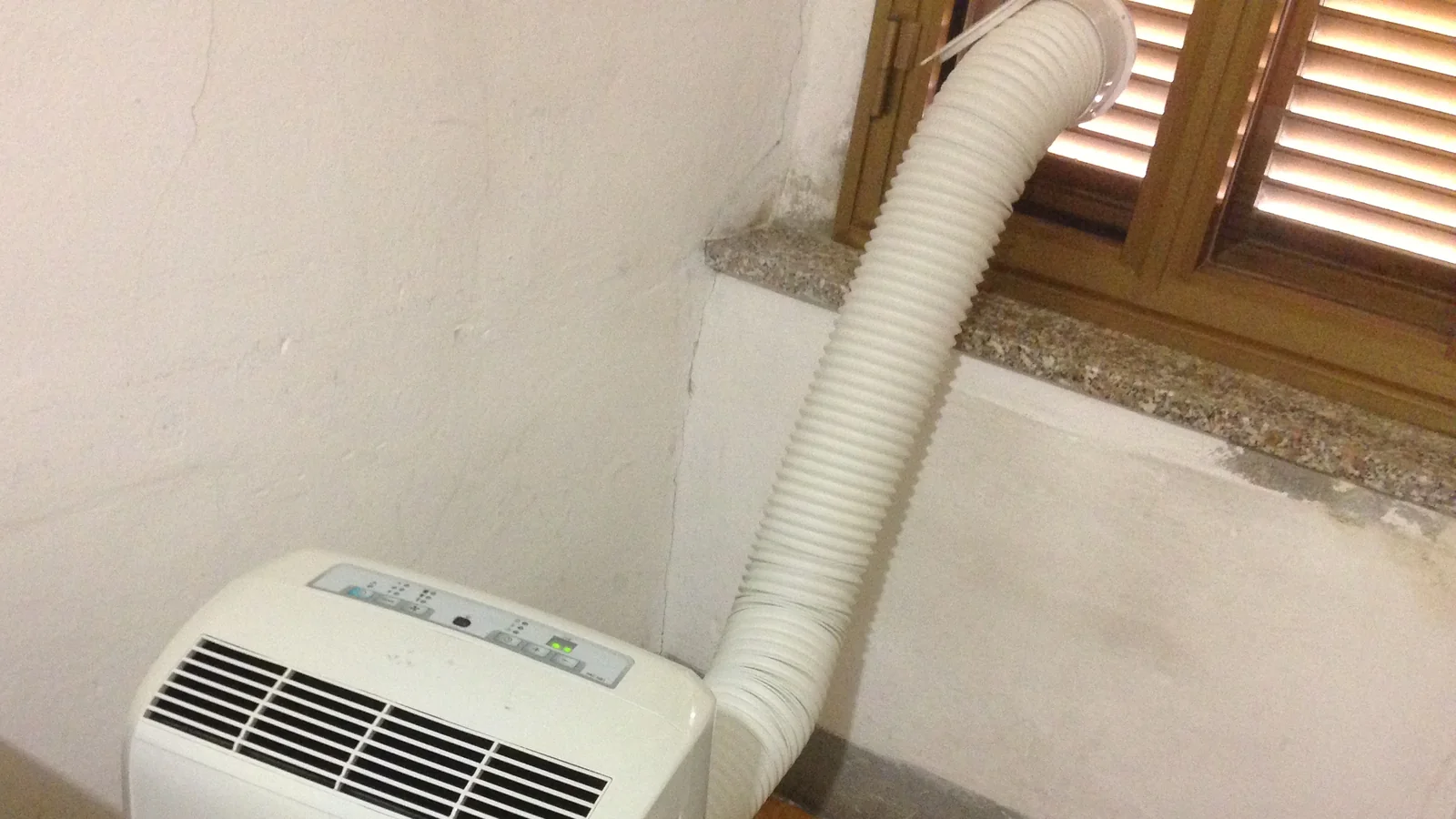
Photo: Nuorese 95 (CC BY-SA 4.0, cropped)
- What is a portable aircon hose, and what is it made of?
- How should the hose be fitted to the window?
- How do you fit both hoses on a dual-hose unit?
- Is the drain hose the same as the exhaust hose?
- What if the hose cracks, tears or goes missing?
- Get the hose right first, then judge the unit
What is a portable aircon hose, and what is it made of?
A portable aircon hose is the wide, ribbed plastic duct that carries hot air from the unit's outlet to a window adaptor, clipping or twisting into each end. Stretching it fully adds heat-shedding length indoors and strains both clips. The narrow tube on some units is a separate drain hose.
How should the hose be fitted to the window?
Fit the hose short and straight, with the unit close to the window and no loop, sag or kink. GE Appliances advises against bending its exhaust hose more than 45 degrees, because sharper bends restrict airflow, cause back pressure and make the output air warm.
- Measure first: slider panels adjust only within a fixed range; measure the opening before buying one.
- Top-hung window: a slider cannot sit in its bottom wedge; use a flexible seal or a board cut to fit.
- Louvre (nako) window: standard kits do not fit; ask the landlord or a technician about a panel.
- Test it running: a tissue that flutters along a panel edge marks a gap.
How do you fit both hoses on a dual-hose unit?
On a dual-hose portable aircond, one hose brings outdoor air in to cool the hot coil and the other sends it out. GE Appliances says disconnecting the intake hose on its GE Profile dual-hose models makes the unit draw indoor air instead, reducing cooling performance.
Keep the two outside ends apart so exhaust does not feed the intake. The portable aircon buyer guide compares the two designs.
Is the drain hose the same as the exhaust hose?
No. The drain hose is a narrow tube on a small water outlet near the base of some portable units. It carries condensate away by gravity, falling the whole way to a floor trap or bucket, so the tank does not fill and stop the cooling.
Use the outlet the manual names for a hose and keep its rubber cap to refit when the hose comes off. The portable aircon repair page covers continuous draining; why a portable unit drips water (in Malay) maps drips to causes.
What if the hose cracks, tears or goes missing?
Replace a cracked, torn or lost hose with the manufacturer's part for that model, ordered by the model number on the rating label. Diameters and end fittings differ by brand, and a loose-fitting generic hose leaks hot air back indoors.
Tape is a stop-gap. Switch the unit off and unplug it before detaching the hose or opening any cover.
| Hose problem | What you notice | Who fixes it |
|---|---|---|
| Kinked or sagging hose | Weak cooling | Yourself: move the unit closer |
| Gap at the window panel | Tissue flutters at an edge | Yourself: reseat and seal the panel |
| Torn hose or broken end fitting | Hot air puffing out | Yourself: fit the model's hose |
| Exhaust hose dripping | Drips at the window | Yourself: remove the sag |
| Drain hose not draining | Tank light stays on | Yourself: make it fall; technician if blocked inside |
Get the hose right first, then judge the unit
If the room stays warm anyway, work through the portable aircon not cold checklist, then book portable aircon repair in Klang Valley. Aircon Hero quotes a portable job after the technician sees the unit, and the customer approves the quote before work starts. WhatsApp a photo to +60 18-355 5162 or use the contact page.
Before ditching the hose, read a portable aircon without a hose. Wall units can join that message: see aircond service and cleaning and residential aircond services.
Frequently Asked Questions
Sources: Portable Air Conditioner - Exhaust Vent Hose (GE Appliances support) (2026-10)
Talk to an Aircon Hero Technician
Seven days a week across Klang Valley. Send the brand, model and what the unit is doing, and the job is quoted before any work starts.